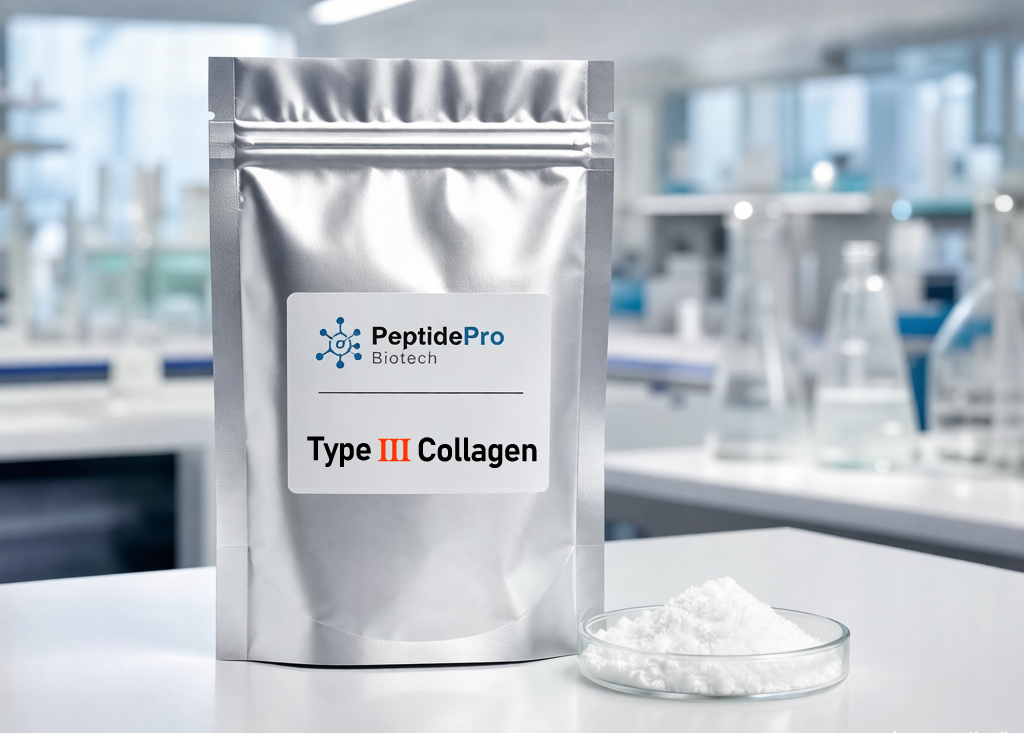
Collagen Type III: The "Youth" Factor & Barrier Restorer
Skin Suppleness, Elastic Recovery, Intense Hydration, Sensitive Skin Rehabilitation, and Post-Aesthetic Procedure Recovery.
$220.00 /g
Product Details
Product Description
Detailed Mechanism of Action & Scientific Rationale:
Collagen Type III is the predominant collagen found in fetal and neonatal skin, earning it the moniker "youth collagen." While Type I provides tensile strength, Type III forms the delicate, flexible reticular fibers that create the skin’s "give" and elasticity. In young skin, the ratio of Type III to Type I collagen is high; however, this ratio drastically declines with age and UV exposure. Peptide Synbio’s recombinant Type III collagen is specifically designed to restore this critical balance. Its unique amino acid composition allows it to form thinner, more branched fibrils compared to Type I. These fibrils weave a fine meshwork throughout the papillary dermis, providing structural support to the microvasculature and nerve endings.
From a cellular perspective, Type III collagen plays a pivotal role in modulating the TGF-β (Transforming Growth Factor Beta) signaling pathway. It helps regulate the inflammatory response during tissue remodeling and is crucial for the assembly of the extracellular matrix (ECM). By replenishing Type III, our ingredient supports the skin's natural ability to "bounce back," reducing the appearance of stretch marks and atrophic scars while improving overall skin texture and resilience.
Expanded Functional Characteristics:
Formation of Reticular Fiber Network (The "Spring" Effect): Unlike the thick, ropelike bundles of Type I collagen, Type III forms a fine, flexible network of reticular fibers. This network acts like thousands of microscopic springs embedded in the dermis. When the skin is stretched or compressed, these fibers absorb the stress and facilitate immediate elastic recovery. This is the key to achieving the coveted "baby skin" effect—skin that is soft to the touch yet firm and resilient.
Superior Hydrophilicity & Moisture Retention: The molecular structure of Type III collagen contains a higher density of hydrophilic sites (hydroxyproline and hydroxylysine residues) compared to other types. This allows it to form a highly effective hydration reservoir within the stratum corneum and epidermis. Our studies show that formulations containing our recombinant Type III can increase skin hydration levels by up to 30% within hours of application, as measured by Corneometer® readings. This hydration is not merely surface-level; it plumps the skin cells from within, smoothing out superficial dehydration lines.
Accelerated Wound Healing & Re-epithelialization: Type III collagen is the first collagen type deposited at the site of tissue injury. It acts as a provisional matrix, guiding the migration of keratinocytes and fibroblasts. Our recombinant Type III mimics this natural biological signal, significantly accelerating the wound healing cascade. It promotes rapid re-epithelialization (the resurfacing of the skin) and reduces the likelihood of abnormal scar formation (keloids or hypertrophic scars) by ensuring a balanced collagen deposition process.
Potent Anti-Inflammatory & Barrier Repair: A compromised skin barrier (as seen in conditions like eczema, rosacea, or post-laser treatment) is characterized by increased Transepidermal Water Loss (TEWL) and heightened sensitivity. Type III collagen interacts with specific receptors on immune cells to downregulate pro-inflammatory cytokines (such as IL-6 and TNF-α). Simultaneously, it stimulates the synthesis of tight junction proteins (like Claudin and Occludin), which are essential for sealing the gaps between skin cells. This dual action rapidly soothes irritation, reduces redness, and restores the integrity of the acid mantle.
Enhanced Cellular Turnover & Texture Refinement: By supporting the healthy functioning of the basal layer, Type III collagen aids in the orderly shedding of corneocytes (desquamation). This results in a refined skin texture, minimized appearance of pores, and a brighter, more even complexion. It effectively addresses the "orange peel" texture often associated with aging or sun damage.
Clinical Efficacy & Performance Metrics:
Elasticity Measurement: Instrumental analysis using Cutometer® MPA 580 demonstrates a significant improvement in skin elasticity parameters (Ua/Uf - immediate distension; Ur/Ue - gross elasticity) after 28 days of use.
Barrier Function: TEWL measurements (Tewameter® TM 300) show a rapid decrease in water loss, indicating successful barrier restoration, particularly in subjects with sensitive or compromised skin.
Sensory Profile: Panelists consistently report a "silky-smooth," non-tacky feel upon application, confirming its superior sensory attributes compared to animal-derived gelatins or lower-quality hydrolysates.
Primary Applications in Formulations:
Hydrating Essences & Toners: Low-viscosity formulas where Type III collagen provides an immediate hydration boost and prepares the skin for subsequent treatments.
Sensitive Skin Care Lines: Soothing creams and serums designed for reactive, allergic, or compromised skin barriers (e.g., atopic dermatitis, rosacea).
Post-Laser & Chemical Peel Recovery: Specialized post-procedure masks and balms used in-clinic to calm inflammation, reduce downtime, and prevent post-inflammatory hyperpigmentation (PIH).
Scar Reduction Gels: Topical treatments aimed at improving the appearance of new scars (surgical, acne, or trauma-related) by modulating collagen synthesis.
"Glass Skin" & "Baby Skin" Serums: High-end K-beauty or J-beauty inspired formulations focused on achieving extreme smoothness, translucency, and plumpness.
Eye Contour Treatments: Gentle yet effective formulas for the delicate periorbital area to reduce fine lines caused by dehydration and improve skin density.
Collagen Type III is the predominant collagen found in fetal and neonatal skin, earning it the moniker "youth collagen." While Type I provides tensile strength, Type III forms the delicate, flexible reticular fibers that create the skin’s "give" and elasticity. In young skin, the ratio of Type III to Type I collagen is high; however, this ratio drastically declines with age and UV exposure. Peptide Synbio’s recombinant Type III collagen is specifically designed to restore this critical balance. Its unique amino acid composition allows it to form thinner, more branched fibrils compared to Type I. These fibrils weave a fine meshwork throughout the papillary dermis, providing structural support to the microvasculature and nerve endings.
From a cellular perspective, Type III collagen plays a pivotal role in modulating the TGF-β (Transforming Growth Factor Beta) signaling pathway. It helps regulate the inflammatory response during tissue remodeling and is crucial for the assembly of the extracellular matrix (ECM). By replenishing Type III, our ingredient supports the skin's natural ability to "bounce back," reducing the appearance of stretch marks and atrophic scars while improving overall skin texture and resilience.
Expanded Functional Characteristics:
Formation of Reticular Fiber Network (The "Spring" Effect): Unlike the thick, ropelike bundles of Type I collagen, Type III forms a fine, flexible network of reticular fibers. This network acts like thousands of microscopic springs embedded in the dermis. When the skin is stretched or compressed, these fibers absorb the stress and facilitate immediate elastic recovery. This is the key to achieving the coveted "baby skin" effect—skin that is soft to the touch yet firm and resilient.
Superior Hydrophilicity & Moisture Retention: The molecular structure of Type III collagen contains a higher density of hydrophilic sites (hydroxyproline and hydroxylysine residues) compared to other types. This allows it to form a highly effective hydration reservoir within the stratum corneum and epidermis. Our studies show that formulations containing our recombinant Type III can increase skin hydration levels by up to 30% within hours of application, as measured by Corneometer® readings. This hydration is not merely surface-level; it plumps the skin cells from within, smoothing out superficial dehydration lines.
Accelerated Wound Healing & Re-epithelialization: Type III collagen is the first collagen type deposited at the site of tissue injury. It acts as a provisional matrix, guiding the migration of keratinocytes and fibroblasts. Our recombinant Type III mimics this natural biological signal, significantly accelerating the wound healing cascade. It promotes rapid re-epithelialization (the resurfacing of the skin) and reduces the likelihood of abnormal scar formation (keloids or hypertrophic scars) by ensuring a balanced collagen deposition process.
Potent Anti-Inflammatory & Barrier Repair: A compromised skin barrier (as seen in conditions like eczema, rosacea, or post-laser treatment) is characterized by increased Transepidermal Water Loss (TEWL) and heightened sensitivity. Type III collagen interacts with specific receptors on immune cells to downregulate pro-inflammatory cytokines (such as IL-6 and TNF-α). Simultaneously, it stimulates the synthesis of tight junction proteins (like Claudin and Occludin), which are essential for sealing the gaps between skin cells. This dual action rapidly soothes irritation, reduces redness, and restores the integrity of the acid mantle.
Enhanced Cellular Turnover & Texture Refinement: By supporting the healthy functioning of the basal layer, Type III collagen aids in the orderly shedding of corneocytes (desquamation). This results in a refined skin texture, minimized appearance of pores, and a brighter, more even complexion. It effectively addresses the "orange peel" texture often associated with aging or sun damage.
Clinical Efficacy & Performance Metrics:
Elasticity Measurement: Instrumental analysis using Cutometer® MPA 580 demonstrates a significant improvement in skin elasticity parameters (Ua/Uf - immediate distension; Ur/Ue - gross elasticity) after 28 days of use.
Barrier Function: TEWL measurements (Tewameter® TM 300) show a rapid decrease in water loss, indicating successful barrier restoration, particularly in subjects with sensitive or compromised skin.
Sensory Profile: Panelists consistently report a "silky-smooth," non-tacky feel upon application, confirming its superior sensory attributes compared to animal-derived gelatins or lower-quality hydrolysates.
Primary Applications in Formulations:
Hydrating Essences & Toners: Low-viscosity formulas where Type III collagen provides an immediate hydration boost and prepares the skin for subsequent treatments.
Sensitive Skin Care Lines: Soothing creams and serums designed for reactive, allergic, or compromised skin barriers (e.g., atopic dermatitis, rosacea).
Post-Laser & Chemical Peel Recovery: Specialized post-procedure masks and balms used in-clinic to calm inflammation, reduce downtime, and prevent post-inflammatory hyperpigmentation (PIH).
Scar Reduction Gels: Topical treatments aimed at improving the appearance of new scars (surgical, acne, or trauma-related) by modulating collagen synthesis.
"Glass Skin" & "Baby Skin" Serums: High-end K-beauty or J-beauty inspired formulations focused on achieving extreme smoothness, translucency, and plumpness.
Eye Contour Treatments: Gentle yet effective formulas for the delicate periorbital area to reduce fine lines caused by dehydration and improve skin density.