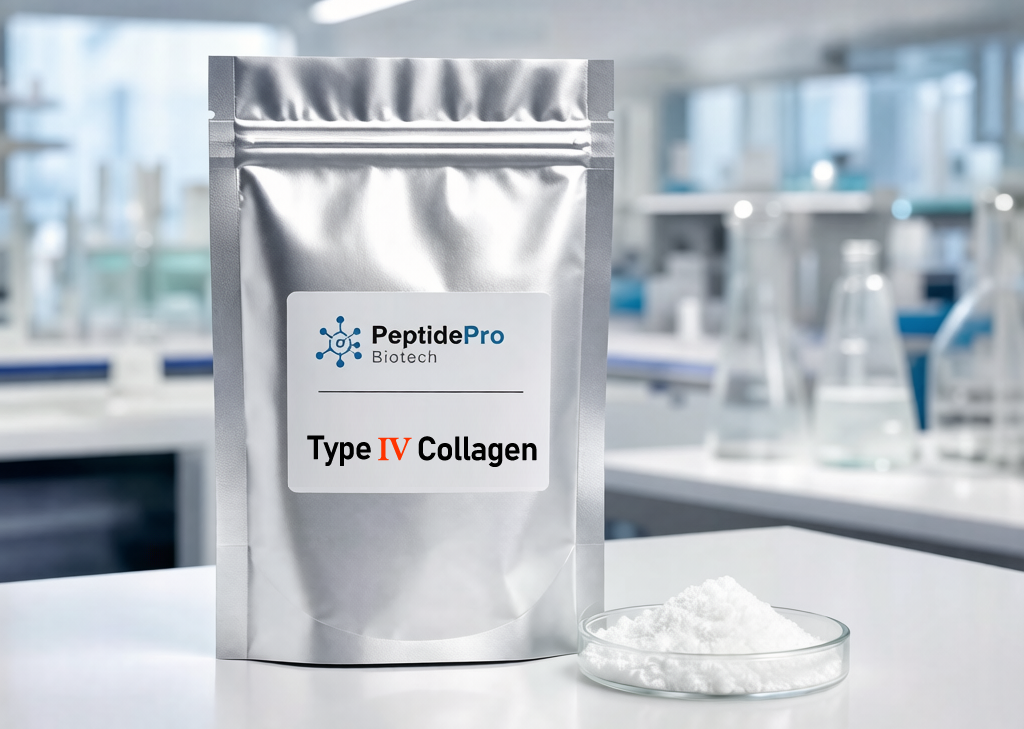
Collagen Type IV: The Basement Membrane Zone (BMZ) Stabilizer & Biological Shield
Dermal-Epidermal Junction (DEJ) Reinforcement, Barrier Integrity, Anti-Redness, Anti-Glycation, Anti-Pollution Defense, and Capillary Fragility Correction.
$240.00 /g
Product Details
Product Description
Detailed Mechanism of Action & Scientific Rationale:
Collagen Type IV is architecturally distinct from the fibrillar collagens (Types I, II, III, and V). Instead of forming rope-like fibers, Type IV collagen constitutes the structural framework of the Basement Membrane Zone (BMZ)—specifically the lamina densa. This ultra-thin, sheet-like network acts as the "concrete foundation" upon which the epidermis rests and the "anchor points" (anchoring fibrils composed mainly of Type VII collagen) attach. With age and chronic UV exposure (solar elastosis), the DEJ flattens, reducing the surface area of contact between the dermis and epidermis, leading to nutrient deprivation of keratinocytes and impaired signal transduction.
Peptide Synbio’s recombinant Type IV collagen is engineered to restore the undulating structure of the DEJ known as the "rete ridge" pattern. It features a unique triple-helix interrupted by multiple non-helical domains, allowing it to self-assemble into a flexible, mesh-like scaffold. This scaffold binds essential proteoglycans like Perlecan and Nidogen, which are critical for trapping growth factors and forming a charged barrier. By reinforcing this junction, our Type IV collagen prevents the physical separation of skin layers (subepidermal blistering) and restores the skin’s ability to filter out harmful agents while retaining vital hydration.
Expanded Functional Characteristics:
Structural Backbone of the DEJ (The Anchoring System): Type IV collagen forms a continuous, flexible network that integrates with laminins to create the structural core of the basement membrane. It is the primary ligand for α6β4 integrins on the hemidesmosomes of basal keratinocytes. By supplementing Type IV, we essentially "re-nail" the epidermis to the dermis. This is critical for preventing skin fragility, improving the skin’s resistance to mechanical stress (friction and stretching), and halting the progression of conditions like epidermolysis bullosa or severe rosacea where the DEJ is compromised.
Selective Filtration & Pathogen Defense (The Biological Sieve): The porous structure of the Type IV collagen matrix acts as a sophisticated filtration system. It is negatively charged, which repels anionic toxins and pathogens while allowing the passage of water, nutrients, and signaling molecules (like IGF-1) from the dermis to the avascular epidermis. This function is vital for anti-pollution skincare. It prevents the infiltration of airborne particulate matter (PM2.5), heavy metals, and environmental allergens into the living layers of the skin, thereby reducing the chronic low-grade inflammation (inflammaging) that accelerates skin aging.
Anti-Glycation & Matrix Integrity Preservation: Glycation is a primary driver of DEJ degradation. Sugar molecules cross-link with collagen fibers, forming Advanced Glycation End-products (AGEs), which turn collagen brittle and yellow. Our recombinant Type IV collagen exhibits a significantly lower density of lysine residues susceptible to glycation compared to aged native collagen. Furthermore, it inhibits the formation of AGEs by acting as a competitive substrate. By maintaining the flexibility and integrity of the DEJ, it prevents the "sagging" effect that occurs when the epidermal anchor points fail, effectively preserving the skin’s architectural blueprint.
Capillary Wall Reinforcement & Anti-Erythema: Type IV collagen is a major component of the vascular basement membrane surrounding capillaries in the papillary dermis. In sensitive skin or conditions like couperose (broken capillaries), this vascular wall weakens. Our Type IV collagen strengthens these micro-vessel walls, reducing their permeability and fragility. This translates to a visible reduction in diffuse redness (erythema) and a decrease in the appearance of telangiectasias (spider veins), particularly in the delicate cheek and nasal areas.
Growth Factor Reservoir & Cellular Signaling: The Type IV matrix serves as a reservoir for various growth factors, including VEGF and FGF. By stabilizing these signaling molecules within the BMZ, it ensures a sustained supply to the basal layer for continuous epidermal turnover and repair. This promotes a healthier, more regular differentiation of keratinocytes, leading to a smoother skin surface and improved reflectance (glow).
Clinical Efficacy & Performance Metrics:
DEJ Contrast Imaging: High-resolution ultrasound and confocal microscopy show improved contrast and definition at the DEJ interface after 56 days of use, indicating restored structural integrity.
Redness Reduction (A*Value): Colorimetric analysis (Chroma Meter) reveals a statistically significant decrease in the red/green axis (A*value) in subjects with sensitive skin or mild rosacea.
Barrier Recovery Rate: TEWL recovery tests post-tape stripping demonstrate a faster return to baseline values, proving enhanced barrier resilience against physical insults.
Primary Applications in Formulations:
Advanced Barrier Repair Creams: Rich emulsions designed to rebuild the skin's foundation for individuals with atopic dermatitis, eczema, or compromised barriers.
Anti-Redness & Rosacea Formulations: Specialized serums and soothing masks targeting diffuse erythema and capillary fragility.
Eye Contour Treatments: Critical for the thin periorbital skin, where it reduces puffiness (by controlling micro-edema) and dark circles (by strengthening fragile capillaries and preventing blood leakage).
Anti-Pollution & Urban Shield Products: Day creams formulated with Type IV collagen to act as a biological shield against urban dust, smoke, and particulate matter.
Mature Skin & Sagging Prevention: High-performance anti-aging formulations aimed at "tightening" the connection between the epidermis and dermis to prevent the hollowing appearance associated with advanced aging.
Post-Injectable & Post-Surgical Care: Used to stabilize the tissue interface and reduce bruising/swelling following minimally invasive procedures like thread lifts or filler injections.
Collagen Type IV is architecturally distinct from the fibrillar collagens (Types I, II, III, and V). Instead of forming rope-like fibers, Type IV collagen constitutes the structural framework of the Basement Membrane Zone (BMZ)—specifically the lamina densa. This ultra-thin, sheet-like network acts as the "concrete foundation" upon which the epidermis rests and the "anchor points" (anchoring fibrils composed mainly of Type VII collagen) attach. With age and chronic UV exposure (solar elastosis), the DEJ flattens, reducing the surface area of contact between the dermis and epidermis, leading to nutrient deprivation of keratinocytes and impaired signal transduction.
Peptide Synbio’s recombinant Type IV collagen is engineered to restore the undulating structure of the DEJ known as the "rete ridge" pattern. It features a unique triple-helix interrupted by multiple non-helical domains, allowing it to self-assemble into a flexible, mesh-like scaffold. This scaffold binds essential proteoglycans like Perlecan and Nidogen, which are critical for trapping growth factors and forming a charged barrier. By reinforcing this junction, our Type IV collagen prevents the physical separation of skin layers (subepidermal blistering) and restores the skin’s ability to filter out harmful agents while retaining vital hydration.
Expanded Functional Characteristics:
Structural Backbone of the DEJ (The Anchoring System): Type IV collagen forms a continuous, flexible network that integrates with laminins to create the structural core of the basement membrane. It is the primary ligand for α6β4 integrins on the hemidesmosomes of basal keratinocytes. By supplementing Type IV, we essentially "re-nail" the epidermis to the dermis. This is critical for preventing skin fragility, improving the skin’s resistance to mechanical stress (friction and stretching), and halting the progression of conditions like epidermolysis bullosa or severe rosacea where the DEJ is compromised.
Selective Filtration & Pathogen Defense (The Biological Sieve): The porous structure of the Type IV collagen matrix acts as a sophisticated filtration system. It is negatively charged, which repels anionic toxins and pathogens while allowing the passage of water, nutrients, and signaling molecules (like IGF-1) from the dermis to the avascular epidermis. This function is vital for anti-pollution skincare. It prevents the infiltration of airborne particulate matter (PM2.5), heavy metals, and environmental allergens into the living layers of the skin, thereby reducing the chronic low-grade inflammation (inflammaging) that accelerates skin aging.
Anti-Glycation & Matrix Integrity Preservation: Glycation is a primary driver of DEJ degradation. Sugar molecules cross-link with collagen fibers, forming Advanced Glycation End-products (AGEs), which turn collagen brittle and yellow. Our recombinant Type IV collagen exhibits a significantly lower density of lysine residues susceptible to glycation compared to aged native collagen. Furthermore, it inhibits the formation of AGEs by acting as a competitive substrate. By maintaining the flexibility and integrity of the DEJ, it prevents the "sagging" effect that occurs when the epidermal anchor points fail, effectively preserving the skin’s architectural blueprint.
Capillary Wall Reinforcement & Anti-Erythema: Type IV collagen is a major component of the vascular basement membrane surrounding capillaries in the papillary dermis. In sensitive skin or conditions like couperose (broken capillaries), this vascular wall weakens. Our Type IV collagen strengthens these micro-vessel walls, reducing their permeability and fragility. This translates to a visible reduction in diffuse redness (erythema) and a decrease in the appearance of telangiectasias (spider veins), particularly in the delicate cheek and nasal areas.
Growth Factor Reservoir & Cellular Signaling: The Type IV matrix serves as a reservoir for various growth factors, including VEGF and FGF. By stabilizing these signaling molecules within the BMZ, it ensures a sustained supply to the basal layer for continuous epidermal turnover and repair. This promotes a healthier, more regular differentiation of keratinocytes, leading to a smoother skin surface and improved reflectance (glow).
Clinical Efficacy & Performance Metrics:
DEJ Contrast Imaging: High-resolution ultrasound and confocal microscopy show improved contrast and definition at the DEJ interface after 56 days of use, indicating restored structural integrity.
Redness Reduction (A*Value): Colorimetric analysis (Chroma Meter) reveals a statistically significant decrease in the red/green axis (A*value) in subjects with sensitive skin or mild rosacea.
Barrier Recovery Rate: TEWL recovery tests post-tape stripping demonstrate a faster return to baseline values, proving enhanced barrier resilience against physical insults.
Primary Applications in Formulations:
Advanced Barrier Repair Creams: Rich emulsions designed to rebuild the skin's foundation for individuals with atopic dermatitis, eczema, or compromised barriers.
Anti-Redness & Rosacea Formulations: Specialized serums and soothing masks targeting diffuse erythema and capillary fragility.
Eye Contour Treatments: Critical for the thin periorbital skin, where it reduces puffiness (by controlling micro-edema) and dark circles (by strengthening fragile capillaries and preventing blood leakage).
Anti-Pollution & Urban Shield Products: Day creams formulated with Type IV collagen to act as a biological shield against urban dust, smoke, and particulate matter.
Mature Skin & Sagging Prevention: High-performance anti-aging formulations aimed at "tightening" the connection between the epidermis and dermis to prevent the hollowing appearance associated with advanced aging.
Post-Injectable & Post-Surgical Care: Used to stabilize the tissue interface and reduce bruising/swelling following minimally invasive procedures like thread lifts or filler injections.